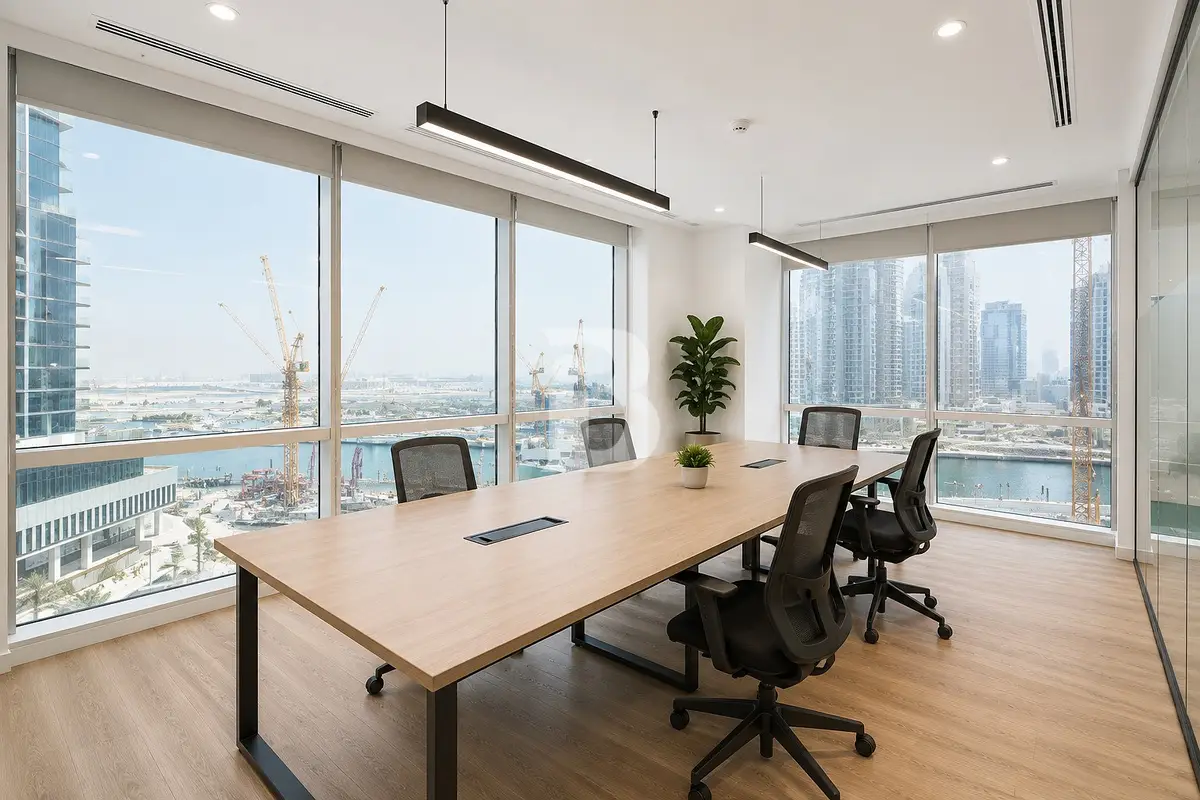
Commercial properties for sale
3 results
The UAE commercial-property market is not one single buying decision. A compact office purchased for an operating team in a business district, a tenanted retail unit bought for income, and an industrial site acquired for logistics each respond to different demand, title, access and licensing considerations. A useful search starts by defining the business or investment case before comparing price: owner occupation, stable rental income, redevelopment potential, a customer-facing location, or an industrial operating base.
Across the Emirates, commercial stock ranges from fitted offices and street retail to warehouses, labour accommodation, showrooms, mixed-use buildings, commercial plots and bulk-unit opportunities. The practical advantage of a UAE-wide search is choice. It lets buyers compare gateway cities, business districts and industrial corridors before committing capital to one locality. The trade-off is that ownership routes, authority requirements, tenant profile and operational access can differ materially from one Emirate or development to another.
Commercial buyers make stronger decisions when they separate the property search into three questions: what the asset must do, who will occupy it, and what has to be true for the purchase to work. An owner-occupier may need a particular layout, parking pattern or service access. An investor needs evidence on lease status, tenant obligations, net operating costs and re-leasing risk. A developer or land buyer needs written clarity on permitted use, height, density, access and approvals before attributing value to future potential.
A UAE-wide buyer should shortlist by operating model first, then compare cities. It is often more productive to compare three assets that serve the same business need across different Emirates than to compare every commercial category within a single city.
Commercial asset | Typical buyer focus | Critical checks before shortlisting |
Office or full floor | Owner occupation, professional-services tenancy or a fitted investment | Usable layout, building access, parking, fit-out approvals, service charges, lease status |
Retail shop or showroom | Customer visibility, destination demand or income from an existing tenant | Frontage, signage, parking, adjacent uses, footfall pattern, trading restrictions |
Warehouse, factory or industrial unit | Storage, production, distribution or a logistics-led investment | Truck approach, loading, power, clear height, yard, fire and safety condition |
Commercial building or plot | Income portfolio, redevelopment or an operating campus | Title, use permissions, tenant schedule, condition survey, utilities, build-out rights |
Offices remain appropriate where a business needs a formal address, client access and a workable floorplate. Their commercial value is shaped by the building, parking, natural light, lift capacity, common areas, fit-out and the local market for that exact size of office. Retail units need a different standard: a shop can look attractive in a listing but still underperform if the entrance, frontage, delivery route or customer catchment does not support the product being sold.
Industrial and logistics assets should be viewed as operating infrastructure. Buyers should walk the vehicle route, inspect loading points, measure working areas and ask what capacity, permits or alterations are needed for the intended operation. Commercial buildings and plots need the broadest diligence because their value may depend on a mix of tenancy, approvals, structural condition, redevelopment scope and financing feasibility.
Dubai offers the deepest spread of office, retail and mixed-use options, with established business districts alongside logistics and industrial locations. A buyer should distinguish between a prestige address, a staff-accessible office, a destination retail unit and an asset whose value relies on loading, yard space or road access.
Abu Dhabi can suit buyers seeking offices, retail or mixed-use opportunities connected to the capital’s business base, while Al Ain is more relevant for local trade, service businesses and operational property. In both markets, the right location depends on customer geography and permitted activity, not simply the building’s appearance.
Sharjah, Ajman, Ras Al Khaimah, Fujairah and Umm Al Quwain expand the search toward industrial land, warehouses, commercial buildings, shops and regional trade locations. Their value proposition is highly asset-specific: access, plot configuration, local catchment, port or highway connection, and the ability to support the intended use matter more than broad regional labels.
An owner-occupier should begin with the business plan, not the advertised asset. Map staff numbers, customer visits, stock movement, meeting rooms, storage, equipment, delivery frequency, security and growth over the next few years. The property should reduce operating friction. Buying a space that is overly constrained, expensive to alter or poorly suited to the activity can lock in a cost that remains long after the initial purchase is completed.
An income buyer has a different job. Existing rent should be examined through the signed contract, payment record, security, renewal position, break clauses, maintenance responsibility, service-charge treatment and the marketability of the unit once vacant. A quoted return is only a starting point; the more important question is whether the asset can sustain occupancy and income under normal market conditions.
Development or land buyers need the most conservative approach. A plot’s value is not established by size alone. The buyer should obtain written confirmation of permitted use, planning parameters, access, utilities, infrastructure obligations, time frames and any third-party approvals. Financial projections should include professional fees, construction contingencies, holding costs, registration and transaction costs rather than treating land acquisition as the full investment.
Ownership and registration conditions are not uniform across the UAE. Confirm the title type, buyer eligibility, authority jurisdiction and any use restrictions for the precise plot, building or unit before paying a reservation amount.
The legal review should also test whether the proposed business activity can operate from the asset. Commercial property can be affected by zoning, building rules, master-community conditions, municipality requirements, free-zone or mainland licensing, fire and life-safety requirements, signage rules and building management procedures. Treating these as post-purchase details creates avoidable exposure. Obtain the relevant confirmations before signing a binding agreement.
A ready vacant asset gives an owner-occupier the clearest route to inspect, measure and plan occupation. It still needs technical and legal diligence, but the buyer can assess the real condition rather than rely on a brochure or indicative plan. A ready tenanted asset can provide an established income stream, but the buyer must understand the tenancy, current rent, tenant obligations, maintenance exposure and the genuine options at expiry.
A future-delivery commercial unit or development-stage opportunity can suit a buyer with a longer operational plan, but it changes the risk profile. Verify the developer or seller obligations, delivery specification, handover conditions, payment schedule, rights on delay, fit-out limitations, parking allocation and the point at which the intended business can legally commence. Do not assume future accessibility, surrounding demand or internal building quality without documentary support.
The usable comparison unit differs by asset. For an office, it may be the true usable floorplate plus the cost of bringing it to an operational standard. For retail, it may be visibility and actual trade potential after all recurring costs. For a warehouse, it is often the working configuration, loading efficiency, power and yard space. For a building, it is income quality, deferred maintenance and re-letting prospects. Price per square foot can help structure a comparison, but it should never replace a physical and legal assessment.
Create a one-page comparison for each shortlisted asset. Include the title type, location, property classification, built-up and usable areas, condition, parking, permitted use, asking terms, annual property costs, required capital works, current lease data, exit buyers and the main unanswered question. This makes hidden differences visible before negotiations turn a weak preference into a commitment.
Comparison factor | Owner-occupier lens | Investor lens |
Location | Staff, customer and supplier journey; operating efficiency | Depth of future occupier demand and resale liquidity |
Condition and fit-out | Cost, downtime and approvals to begin operating | Capital expenditure, maintenance risk and appeal to tenants |
Tenancy | Vacant possession or a workable handover timetable | Lease term, tenant quality, payment evidence and renewal risk |
Recurring costs | Service, utilities, insurance and operational obligations | Net income after owner obligations and vacancy allowance |
Permissions | The business can lawfully carry out the intended activity | Use is marketable to a sufficiently broad tenant pool |
Commercial due diligence should be coordinated, not treated as a document-collection exercise. Start with title and seller authority, then review the property’s permitted use, plans, condition, existing leases and transaction history. A property inspection should look beyond finishes. For offices, check systems, common areas and access. For retail, inspect visibility, storage, extraction or technical needs where relevant, and delivery constraints. For industrial assets, inspect structure, loading, services, safety equipment and the real working route for vehicles.
Ask for the documents early: title or ownership record, site or unit plan, seller identification and authority, tenancy schedule and signed contracts if occupied, service-charge or maintenance history where applicable, notices, approvals, fit-out permissions, utility information and any existing claims or violations. Have legal, technical and financial advisers review the information that affects your decision. A seller’s marketing pack is not a substitute for independent verification.
Confirm the seller can transfer the asset and that the title, plot number and unit plan match the property being viewed.
Verify the permitted commercial use and identify approvals required for your activity, fit-out, signage or operational changes.
Inspect structural, MEP, fire-safety, access and maintenance condition with an appropriate professional where the asset warrants it.
For occupied property, review original leases, payment evidence, deposits, notice provisions, operating costs and renewal or break dates.
Budget separately for registration, professional advice, finance, insurance, fit-out, remedial works and contingency rather than relying on the agreed price alone.
Start with a written acquisition brief. Define the asset type, area, minimum usable space, maximum total capital commitment, required access, permitted use, parking, timing and whether the purchase is for occupation, income or development. Use this brief to filter listings and arrange viewings. After each viewing, score the property against the same criteria so that a polished presentation does not outweigh operational reality.
Once a preferred asset emerges, proceed through diligence before agreeing final terms. Clarify the conditions precedent, documents to be delivered, access for inspection, responsibility for existing defects, treatment of deposits and tenants, transfer timeline and costs. Finance-dependent buyers should align their approval process with the contract timetable. The objective is a transaction that is documentable, fundable and fit for the intended use—not simply the fastest possible signature.
Across the UAE, the same asset can have a very different buyer pool depending on its Emirate and submarket. An office close to a corporate district, a warehouse on an industrial corridor and a retail unit within a community should each be assessed against a distinct source of demand. When comparing between Emirates, make the comparison operationally fair: compare access, title route, land use, annual ownership costs and the depth of the relevant occupier market—not only the starting purchase price.
For a portfolio buyer, diversification should be intentional. Mixing a small office, a warehouse and a retail unit can spread exposure only if each asset has a clear tenant profile, documented lease position and management plan. Ownership across Emirates can also mean different registration processes, service providers and compliance steps, so governance should be designed before completion rather than after it.
Before an offer is made, turn the property into a complete decision file. Record the expected purchase amount, all transaction and professional costs, finance assumptions, immediate capital works, recurring ownership costs, fit-out or leasing allowance, tax treatment where professional advice is required, and a contingency. This avoids a common commercial-property mistake: evaluating the asset against the cash needed to sign rather than the capital needed to own and operate it properly.
Maintain an evidence file for the decision: the source documents, site photographs, measured plan, inspection observations, title and authority checks, tenant information, comparable rationale and a list of conditions that must be resolved before completion. This record is useful during negotiation and remains valuable after transfer, particularly where future management, refinancing, re-letting or resale requires a clear explanation of the asset.
Price is only one term. A commercial buyer should seek clarity on deposit treatment, document delivery, inspection access, timing, vacant-possession or tenant handover, seller warranties, responsibility for arrears or defects, and the approvals required for transfer. Terms should reflect the property’s actual risks. If a critical legal, technical or tenancy point cannot be verified, it should be resolved before the agreement becomes unconditional.
For a cross-Emirate search, standardise what is being compared. Ask each seller or agent for the same information: ownership record, permitted use, site plan, property costs, current lease documents, parking, access, services, condition and transfer steps. Different local practices can otherwise make one asset appear simpler or cheaper only because key information has not yet been disclosed.
Use the final negotiation period to close the gap between assumption and evidence. If the property will be owner-occupied, the operational team should sign off on layout, access, service capacity and fit-out scope. If it will be leased, the commercial case should be tested against the actual lease documents and a realistic replacement-tenant profile. If it will be developed, obtain the authority and technical confirmations that make the assumed scheme viable. Each route needs a clear go/no-go test.
The final decision should be simple enough to explain in one sentence: this asset meets a defined use, carries understood legal and physical risks, can be afforded on a fully loaded basis, and has a credible future occupier or exit market. If that sentence cannot be supported by the documents and inspection evidence, continue the diligence rather than letting momentum make the decision.
The acquisition plan should continue beyond transfer. Set up document control, insurance, keys and access, service and utility accounts, condition records, a maintenance log, tenant communications where relevant, and a timetable for any fit-out or repairs. For an operating business, this prevents the purchased asset from becoming a bottleneck. For an investor, it creates the records needed to manage income, renewals and future disposition professionally.
Review the initial assumptions after occupation or the first quarter of ownership. Compare actual costs, required repairs, access experience, tenant performance and leasing interest against the purchase case. This does not change the completed transaction, but it helps the owner make informed decisions on capital improvements, lease strategy, expansion or disposal while the asset is still being actively managed.
Finally, keep the acquisition brief active until the property is functioning as intended. If a detail changes—an approval is delayed, a repair is larger than expected, a tenant seeks different terms or a finance condition shifts—return to the original decision criteria. A commercial purchase remains sound when the buyer can explain how the asset will be used, funded, maintained and exited under realistic conditions, not merely how it was presented at viewing.
Use Propertify to shortlist commercial assets by location, property type and purchase objective. Compare: commercial properties for sale in Dubai, commercial properties for sale in Abu Dhabi, commercial properties for sale in Sharjah, commercial properties for sale in Ajman. Review the documents, property condition and practical requirements alongside every listing before taking the next step.
Six reasons buyers and sellers choose Propertify for their most important decisions.
Listings reviewed by our team before they go live.
A streamlined digital process from enquiry to close.
Local agents with deep community knowledge.
Properties across all 7 Emirates — from Dubai to Fujairah.
Round-the-clock assistance in English and Arabic.
Transparent pricing from day one — no surprises, ever.